We continue to perceive the light of stars years after their disappearance. On Earth, billions of kilometres away, humans observing their brightness do not imagine that what they see no longer exists. Stars are born, live for a while, then die. Some go out slowly, others explode, but in the end they are gone.

Let us imagine for a moment that the same thing happens to human beings, and that after our hearts have stopped beating, we still emit fossil radiation for generations that can be seen from space.

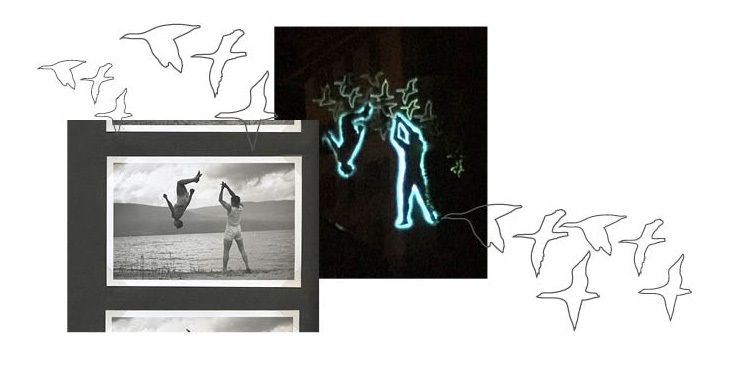
The stardust - memory project explores this idea, using private photographic archives.

How it works:

In a neighborhood of a given city, residents are invited to share their family photos. Pictures of yesterday’s life, happy or solemn moments, seized on the spot or on the contrary, posed in scenes staged: family albums are full of trivial or incredible situations and offer many possibilities of variations. So many traces of ordinary heroes forever gone.

The photographs are then transformed, the characters being reduced to simple silhouettes, detached from their context: they are revealed in their most elementary humanity. Around them, graphic and ornamental elements seem to float in the air, as indications of an earlier life, dreamed or real.

The resulting images are projected on the walls of the neighborhood using gobo projectors. Like good-natured ghosts, the halo silhouettes seem to watch over the inhabitants of today, once night falls.

In parallel with the projections, this website reveals the original images together with the projected image, as well as a notice relating to each photograph: history of the person represented, the family, or the period.

For each city, the texts are written by a native writer of the place. They are published in the original language of the author, with an English translation.

By unveiling these intimate and private elements in the public space, the stardust - memory project creates links between people and times, thus offering a contemporary evocation of what constitutes the society of humans, beyond geographical and temporal boundaries.

A project by Sophie Guyot

Sophie Guyot is a visual artist. She lives and works in Lausanne (CH).
After studying literature and art history, she began working as a self-taught artist, creating visual art centered on light, her medium of choice. Sophie Guyot approached light in two phases: first narratively, then technically—a way of striving toward what she calls a “poetics of the everyday.” It is from the concrete—from contact with the material and the relationship with the space to be occupied—that the desire and the concept emerge.
In recent years, Sophie Guyot has focused on large-scale projects that often address environmental themes treated as metaphors for the general state of humanity. What matters is not the scale, whether she thinks big or small: amoebas, cocoons, ghost towns—the palette employed by Sophie Guyot evokes the light of the day’s extremes, sculpting this source by containing it rather than letting it radiate, a unique way of transforming this material and bringing it close to the viewer.


Her work can be seen at www.sophieguyot.ch

The stardust memory project is supported by: